
#HERIspotlight: Keane Wanza
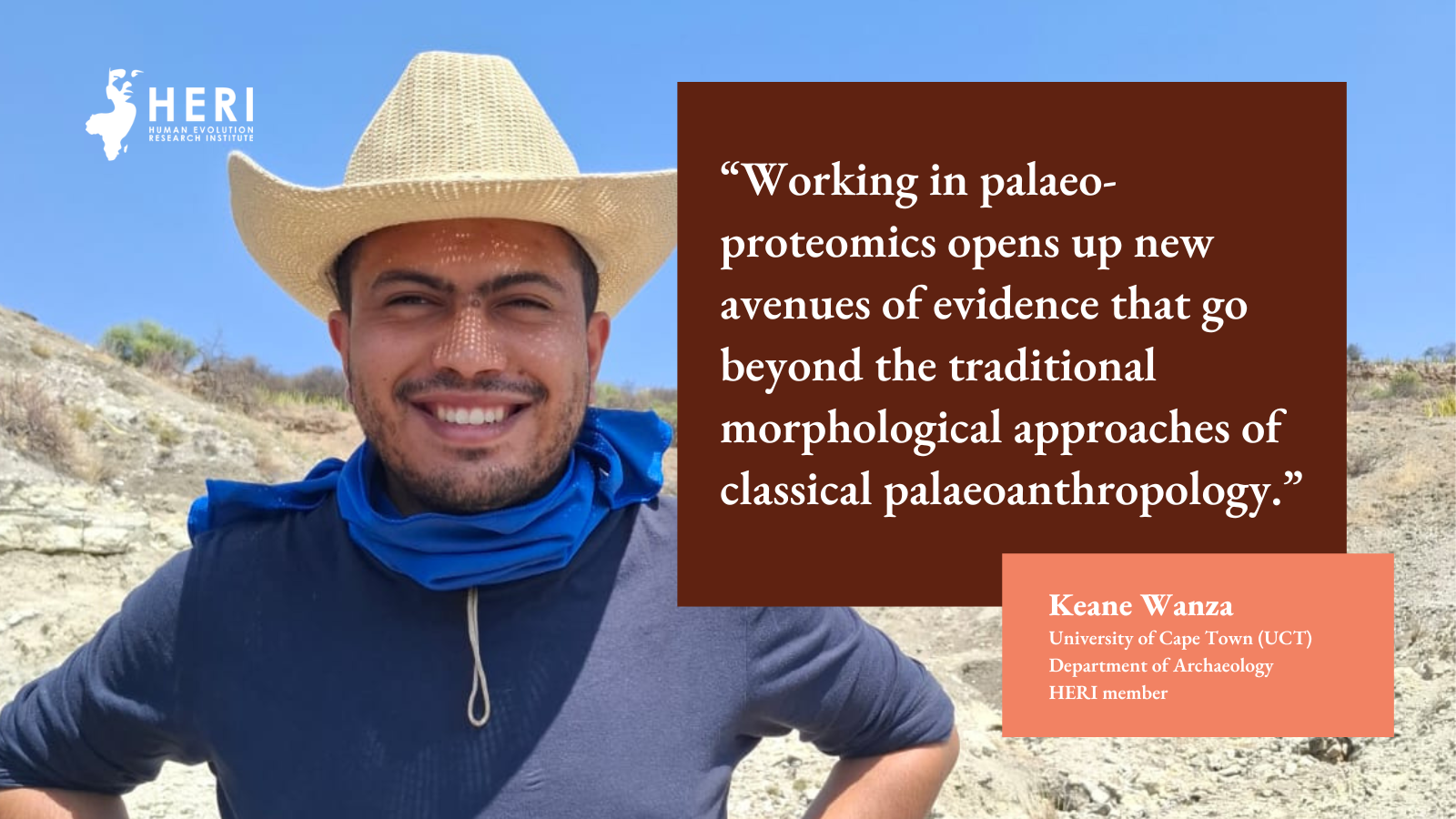
Keane Wanza is a Master's student in the Department of Archaeology at the University of Cape Town (UCT), supervised by Human Evolution Research Institute (HERI) Co-director Professor Rebecca Ackermann and co-supervised by HERI research associate, Dr Palesa Madupe of the Max Planck Institute.
His research applies palaeoproteomics, a rapidly advancing field within palaeoanthropology, to investigate early hominin evolution. Specifically, Keane is exploring the feasibility of applying contemporary palaeoproteomic techniques to Plio-Pleistocene fossil material from East Africa.
Building on his Honours project, which involved palaeoproteomic analyses of faunal material from Omo, Ethiopia, his Master's research focuses on material from Hadar, Ethiopia. To support this work, Keane received specialised laboratory training at the GLOBE Institute at the University of Copenhagen under the guidance of Madupe.
His academic journey has already spanned international borders. His Honours research enabled him to attend the 2024 American Association of Biological Anthropologists (AABA) conference in Los Angeles, while his Master's project took him to Addis Ababa to analyse the Hadar collection at the National Museum of Ethiopia.
In 2025, Keane joined fellow Master’s student Akira Banwari for the Laetoli field season in Tanzania, led by HERI Research Associate Dr Charles Musiba of Duke University. Marking his first major fieldwork experience, the expedition provided invaluable contextual insight into the environments from which his research materials originate.
What excites you most about palaeoscience?
I am in the unique position of working at the forefront of palaeoscience through my application of palaeoproteomics. This field opens up entirely new avenues of evidence – specifically, biomolecular data - that go beyond the traditional morphological approaches of classical palaeoanthropology. It is exciting to explore these new frontiers and contribute to a deeper understanding of early human evolution.
Describe your research in three words.
Palaeoproteomics in East Africa
Who is your biggest inspiration?
My biggest inspiration is my parents. My mother is my greatest supporter, and both of my parents have made countless sacrifices to allow me to pursue my dreams. I am deeply grateful, and I hope to honour their support through my achievements and make them proud.
What has been your biggest academic challenge?
One of my biggest challenges has been pursuing research in a largely unexplored area, both geographically and academically. This includes limited prior research to guide my work, difficulties in obtaining suitable samples, and navigating environmental conditions that are not always ideal for palaeoproteomic analysis.
What is the soundtrack to your studies?
I tend to listen to music that motivates and uplifts me while I work. One song that stands out is Rise by The Glitch Mob, Mako, and The Word Alive.