
New book with HERI contributions presents latest Paranthropus research - and remaining questions
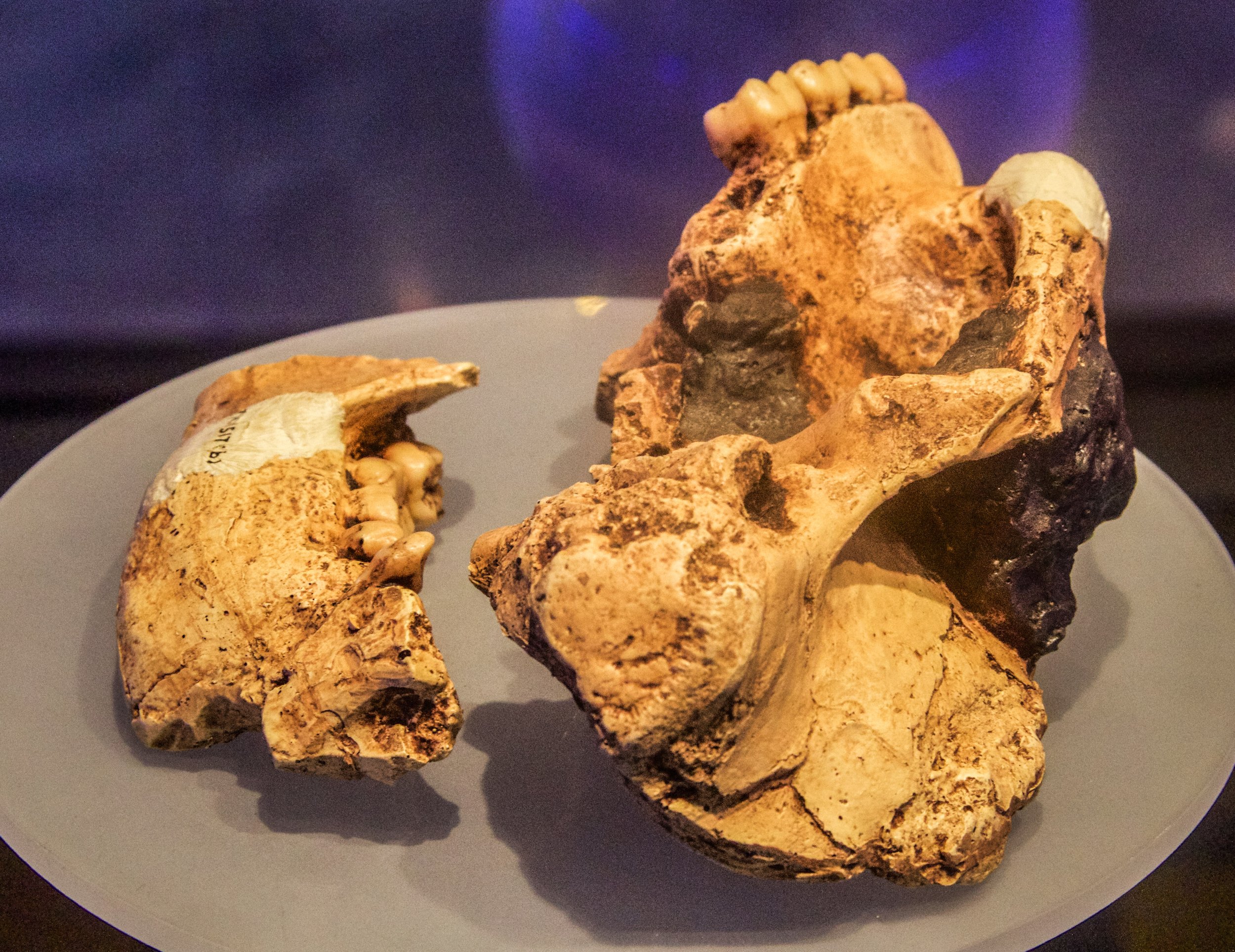
Partial Paranthropus robustus skull from Kromdraai. Partial cranium and mandible (TM1517). Discovered 1938 at the Sterkfontein caves. Credit: Mike Peel/Wikipedia
With a name that means “beside human”, Paranthropus is a fascinating, enigmatic genus of bipedal prehuman or hominin that lived in southern and eastern Africa between 2.6 and 1.2 million years ago. Considered to be a side branch of our evolutionary tree, Paranthropus coexisted with several early Homo species, including ancestors of modern humans. Yet Paranthropus followed a very different evolutionary path.
Since the first fossils were discovered in the 1930s, Paranthropus discoveries have raised more questions than answers. Scientists still don’t fully understand where Paranthropus came from, how it lived, and why it went extinct.
South African researchers at the Human Evolution Research Institute (HERI) at the University of Cape Town (UCT) are playing a leading role in uncovering new evidence around Paranthropus and its legacy. In a new book published this year by Springer on the palaeobiology of Paranthropus, HERI researchers contributed chapters on the reasons for its unique craniomandibular morphology (the structure and shape of the head and jaw), and a model for dating fossil evidence from the Cradle of Humankind, where all the southern African fossils are found.
“Paranthropus is one of the great questions of human evolution. While technological advances over the past 20 years have shed more light on its evolution, big questions still remain,” says HERI Co-director, Associate Professor Robyn Pickering.
“This is the first comprehensive book on Paranthropus since 1988, and HERI’s contributions showcase the incredible research being done in Africa by African researchers to find answers."
From schoolboy find to global sensation
The first fossil evidence of Paranthropus was discovered by a schoolboy in 1938, who was a guide in the Sterkfontein caves, just north of Johannesburg, and now part of the Cradle of Humankind. The boy, Gert Terblanche, had found most of a cranium and lower jaw at a nearby farm called Kromdraai. These were excitedly shown to Robert Broom, who was the Assistant for Palaeontology and Physical Anthropology at what was then the Transvaal Museum (now Ditsong: National Museum of Natural History).
When Broom visited Kromdraai, he recovered more of the cranium (TM 1517) that became the type specimen of Paranthropus robustus. Since then, more Paranthropus fossils have been recovered from five other caves at the Cradle of Humankind, bringing the total to six - Coopers, Drimolen, Gondolin, Kromdraai, Sterkfontein and Swartkrans.
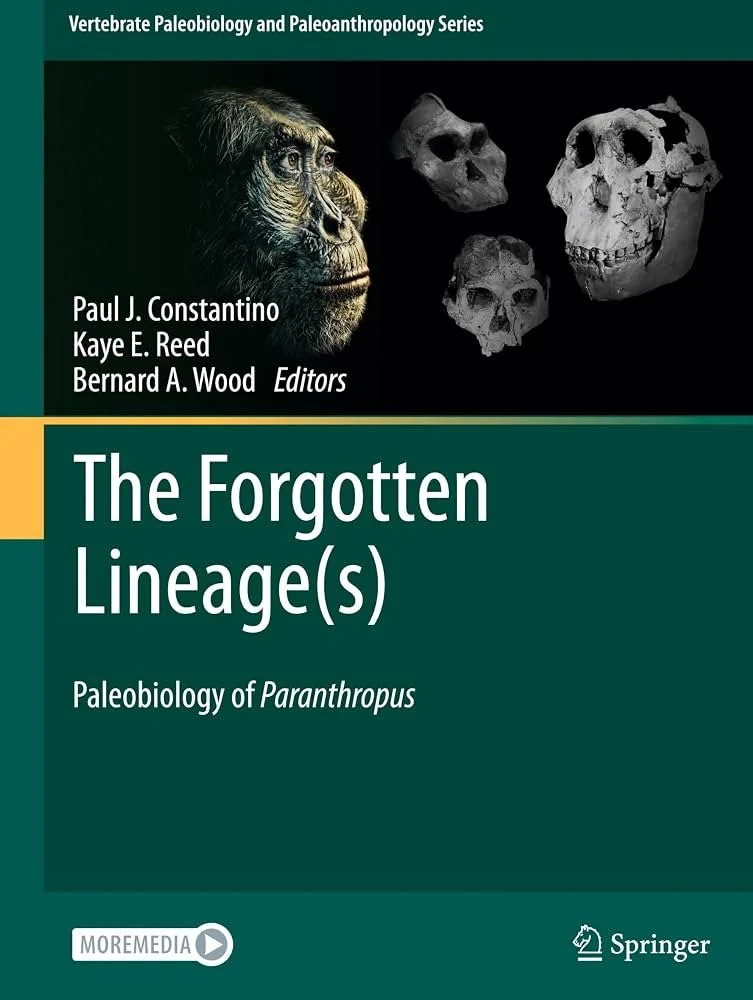
The Forgotten Lineage
HERI researchers contributed chapters to a new book published this year by Springer on the palaeobiology of Paranthropus.
The Paranthropus puzzle
Piecing together the life (and death) of Paranthropus is important for scientists, as it holds clues for understanding our own genus, as well as evolutionary processes in general. At least three distinct species of Paranthropus survived for a combined period of around 1.5 million years - significantly longer than our own species, Homo sapiens, which has only existed for around 300,000 years. This raises the question, if Paranthropus survived for that long, why couldn’t it survive even longer?
Today, only one species of hominin exists (us) and we are genetically very similar to each other, but multiple Paranthropus species coexisted with other hominins, including early Homo species, in eastern and southern Africa, and most probably interacted with them. This difference is leading scientists to ask, what role did Paranthropus play in the evolutionary context in which we evolved?
In the papers published in this volume, HERI researchers are working to answer these questions. Advances in technology available at UCT have enabled the institute's researchers to accurately date the fossil remains from the Cradle of Humankind and compare them with the remains from eastern Africa for the first time. Other HERI researchers are working to understand the evolutionary mechanisms behind the unique morphology (robust skull and jaw) of Paranthropus - is it random chance, is it natural selection - and can we see drivers of evolution by looking at these fossils?
Unique morphology of Paranthropus
Paranthropus was nicknamed “Nutcracker Man” for its large cheekbones, jaws, and molars, which were once thought to be adaptations for eating hard foods like nuts. However, recent research suggests this was not the case. Scientists now believe that Paranthropus had a very varied diet, consisting mostly of tropical grasses and sedges, and seemingly only used its strong teeth and jaws as a fallback during times of food shortages.
So then, why did Paranthropus evolve this way? One of the book chapters details research led by HERI Alumni Nomawethu Hlazo, which used a methodology stemming from evolutionary biology to challenge this long-held assumption about Paranthropus’ evolution.
Drawing on previous research by HERI’s Lauren Schroeder and the institute’s Co-director, Rebecca Ackermann, Hlazo wanted to determine whether Paranthropus’ evolution could have been driven in part by neutral evolutionary processes such as genetic drift. This is when traits become more or less common in a population simply due to chance.
The results revealed that this was highly likely to be the case for most skull traits, with no strong evidence of natural selection, pointing instead to neutral processes. This aligns with the findings on Paranthropus’ diet, which suggests that the hominin’s unique morphology was not purely adaptation-driven. Of course this raises even more questions for researchers, but Hlazo’s findings have opened up a new direction to explore.
Dating Paranthropus robustus
In a similar vein, a chapter by HERI’s Tara Edwards and its Co-director Robyn Pickering challenges a long-held assumption in geological sciences that the fossil remains of Paranthropus robustus in southern Africa cannot be dated as accurately as its eastern African counterparts.
Thanks to the volcanic ash and sediment deposits found in eastern Africa, scientists have been able to use radiometric dating (argon-argon) to determine the age of Paranthropus aethiopicus and Paranthropus boisei. However, dating the remains of Paranthropus robustus in South Africa is much more challenging, due to the geological and geographical differences between the regions.
While eastern Africa's Rift Valley preserves fossils in lake and river sediments, interbedded with volcanic ash layers, southern African fossils are preserved in eroded remains of what were underground cave systems, where they have been washed in and buried by layers of sediment. This requires a completely different dating technique, Uranium-Lead (U-Pb) dating of rocks called flowstones to determine the age of the fossils sandwiched between them.
Pickering has been at the forefront of this dating process for many years, and in this chapter with Edwards, sets up a local chronology for the cave sites in South Africa that can be directly compared to time equivalent deposits in eastern Africa. This is the first time any researchers have been able to do this, and there is potential for it to open more research between the two regions. Pickering and Edwards also work hard to dispel the long held narrative that the geology of these southern African caves are too complex to understand, and propose a new, simple set of descriptions for all the variations of the deposits the fossils are found in.
HERI leading the future
While this book was in production, notable support for meeting the research opportunities it presents have been made. At UCT, for example, investment through the Department of Science and Innovation (DSI)’s BioGeoChemistry Research Infrastructure Platform (BIOGRIP) has been made to expand the technological facilities in the Department of Geological Sciences with a new facility carrying cutting-edge equipment including a laser ablation system and a new generation, high resolution, single collector mass spectrometer.
This will enable HERI PhD student, Georgina Luti, to finish dating the Paranthropus fossil deposits from the Cradle of Humankind, work that is extremely important for shedding light on the relationship between the eastern and southern African Paranthropus populations - who appears first, who goes extinct first, and this unique biology that they appear to share - you need to be able to accurately date them.
HERI is also in the process of installing a palaeoproteomics laboratory within the Archaeology Department at UCT. In addition to the work described above, HERI researchers led by Palesa Madupe have recently pioneered palaeoproteomic studies of Paranthropus and other hominin species, which are linking genetics and morphology for a better understanding of the differences and similarities between extinct hominins.
While these facilities are hosted at UCT, they can be accessed by researchers from institutions in Africa and African scholars from the diaspora, specifically through the Pan-African Consortium for Human Evolution (PANACHE). With training, collaboration and partnerships among institutions in South Africa, Kenya, Ethiopia, and globally, PANACHE ensures that African researchers can contribute to and lead future discoveries that shape future research on Paranthropus.