
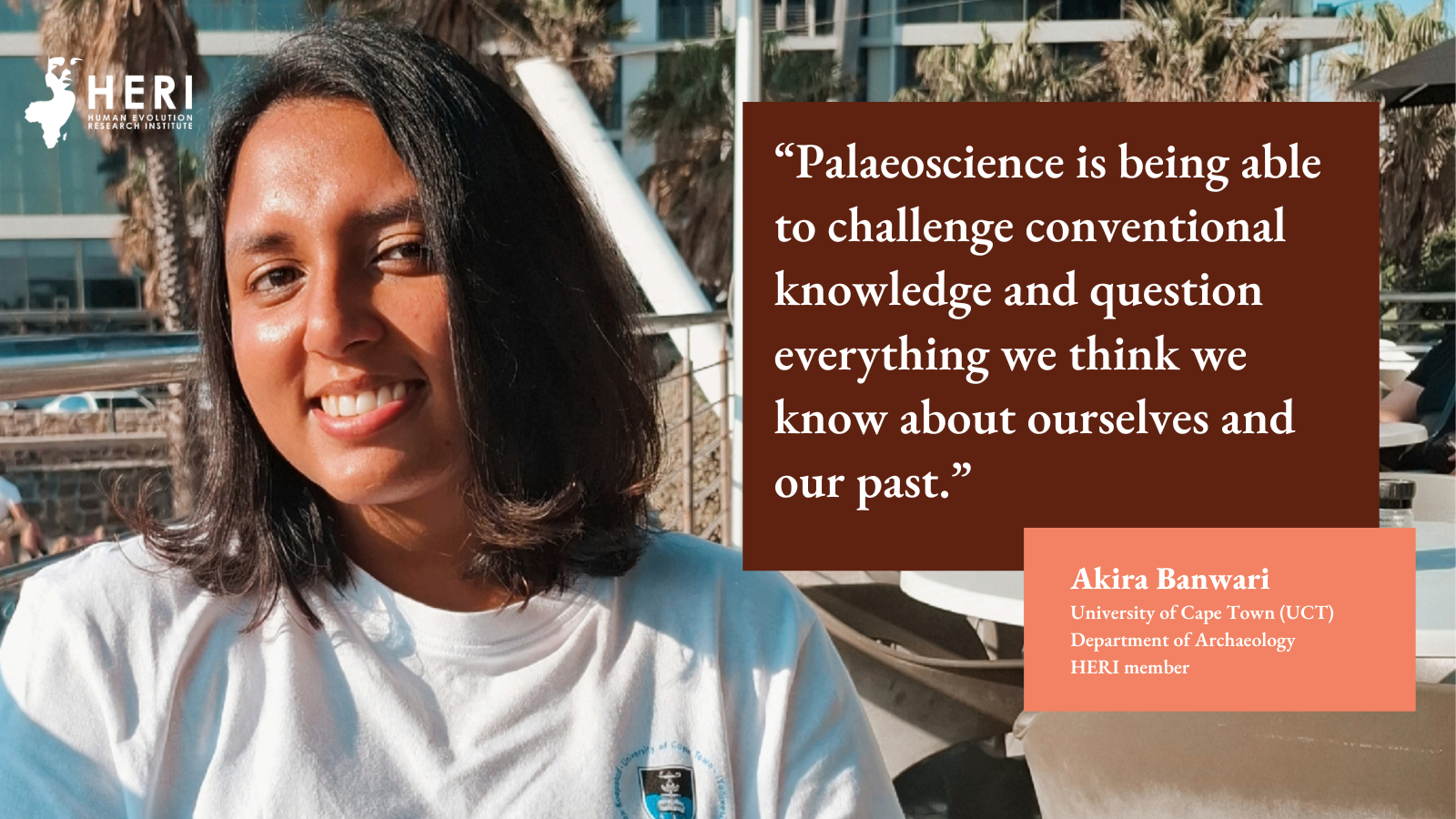
Akira Banwari is a master’s student in the Department of Archaeology at the University of Cape Town (UCT), with a research focus on bioarchaeology, and understanding the implications of our evolutionary past for health and disease.
Banwari investigates bone disease in pre-colonial South Africa, focusing specifically on Osteoporosis and Paget’s disease, a condition that causes bones to become weakened and deformed. Conditions like these have been largely overlooked in sub-Saharan Africa, partly due to assumptions around the preservation of human remains and the lower reported susceptibility of African populations compared with populations of European descent.
The result is limited clinical and archaeological data from African populations, both historically and today, that can complicate diagnosis and contribute to an incomplete understanding of the prevalence and history of these diseases on the continent. Banwari’s work can change that.
Banwari’s research brings an important archaeological perspective to the study of bone disease, using evidence from the past to broaden our understanding of how these conditions have affected human populations over time. In doing so, her work can contribute to more inclusive narratives of health and disease that better reflect the experiences of African populations.
Beyond her research focus, Banwari has also participated in international research collaborations through the PANACHE network, managed by HERI. In 2025, she joined the fieldwork season at Laetoli, Tanzania, under the guidance of Professor Charles Musiba. There, she developed valuable practical skills in site reporting, site conservation and data collection, as well as gaining experience with LiDAR, photogrammetry and basic zooarchaeology.
“By building new knowledge where data are lacking, Akira is helping us tell a more complete story of health and disease in our South African past, and showing why it matters to have diverse voices and perspectives shaping the future of science,” says HERI Co-director Professor Rebecca Ackermann, who supervises Banwari alongside Dr Tessa Campbell.
What excites you most about palaeoscience?
What excites me most about palaeoscience is being able to challenge conventional knowledge and question everything we think we know about ourselves and our pasts. In a way, we are writing and rewriting history.
Describe your research in three words.
Pre-colonial bone diseases.
Who is your biggest inspiration?
In my personal life, my biggest inspiration would be my parents and grandparents, who all made many sacrifices throughout their lives that ultimately led to me being where I am today and being able to study what I do.
As an academic, I am inspired by my supervisors, Professor Becky Ackermann and Dr Tessa Campbell. I am always in awe of their vast knowledge and contributions to our field of study.
What has been your biggest academic challenge?
There have been several challenges throughout my academic career. Diseases in ancient populations are not a well-studied or well-funded field. However, my biggest challenge has been having to create our own databases for this research.
Osteoporosis is diagnosed based on measurements of a person's Bone Mineral Density (BMD). However, even in clinical practice, the databases used by BMD scanners are largely based on measurements from people of European descent. This is problematic because what is considered “normal" or "healthy" BMD can differ across populations. For Indigenous populations, such as the San and Khoe populations included in my research, there is essentially no data on what constitutes normal and healthy BMD, or on the prevalence of bone diseases in these populations.
What is the soundtrack to your studies?
The soundtrack to my studies would probably be “Champion” by Fall Out Boy. The song’s message is quite inspiring, and I think it perfectly describes my relationship with my research.