
A landmark year for HERI women of colour in palaeoscience
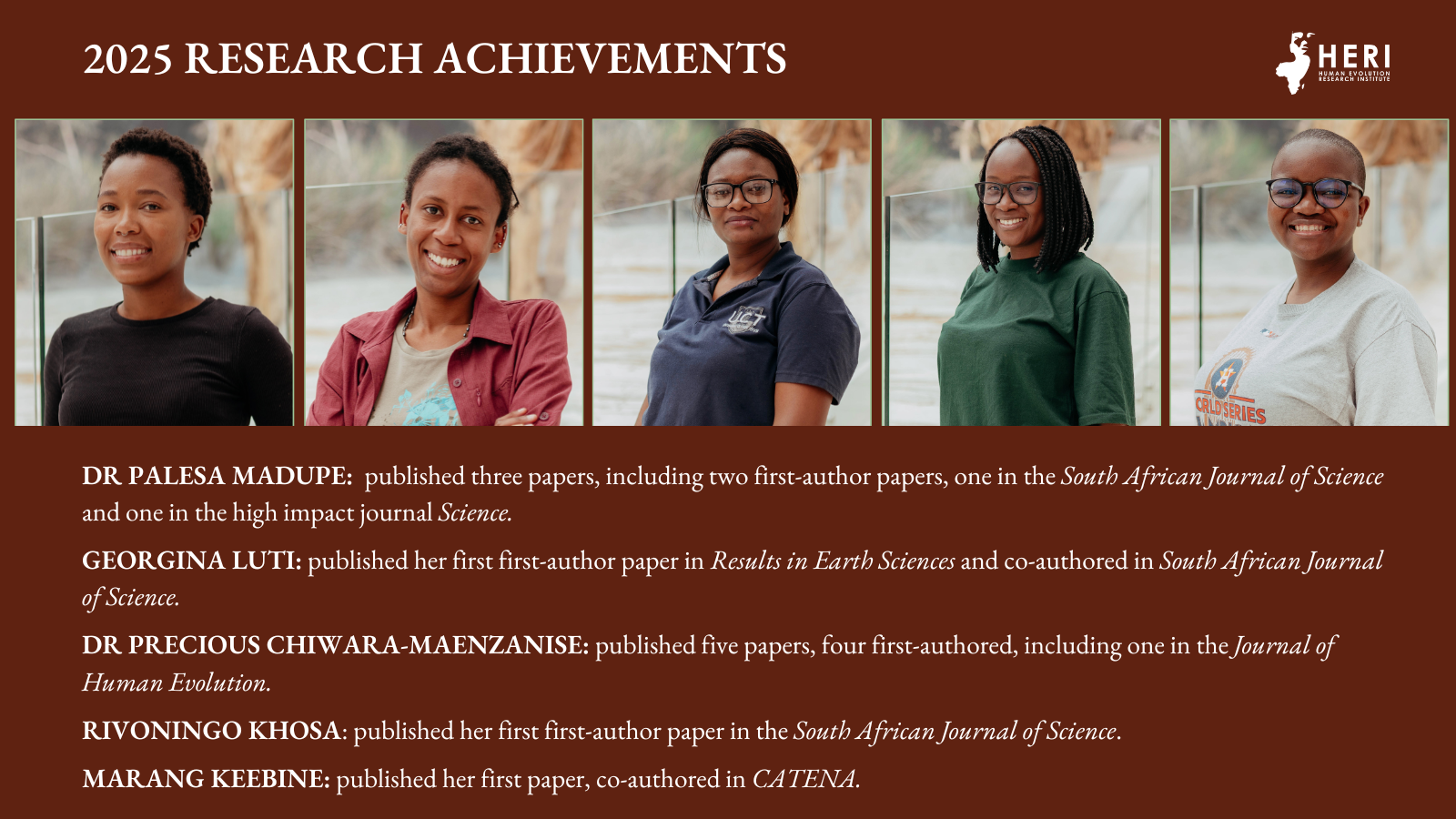
HERI postgraduate women of colour published 12 significant works, signalling the influence of Black women in African palaeoscience.
Last year was a remarkable year for research produced by members of the Human Evolution Research Institute (HERI) at the University of Cape Town (UCT), with several ground-breaking research contributions from its members and students.
Among these, 12 ground-breaking publications from its postgraduate women of colour released in 2025 stand out as an example of HERI’s commitment to driving research excellence among the next generation of women in human evolution.
Across palaeoanthropology, archaeology, geochronology, landscape evolution and planetary geology, the works were published by women at Masters, PhD, and postdoctoral levels. The publications pushed disciplinary boundaries and reshaped long-standing scientific debates, but also signal a transformative shift in who is shaping palaeosciences, a traditionally male-dominated discipline.
“As HERI continues to support researchers across career stages, 2025 stands as a powerful reminder that when Black women are supported, centred, and trusted as knowledge producers, the entire field moves forward,” says HERI Co-director Professor Rebecca Ackermann.
Dr Palesa Madupe: Unlocking Hominin variation with palaeoproteomics
Palesa Madupe’s research applies palaeoproteomics, the study of ancient proteins, to questions of hominin diversity and evolution in southern Africa. Her work is the first ever application of these techniques to ancient African hominins - truly groundbreaking!
In her first first-authored paper, in the South African Journal of Science, Madupe demonstrates protein preservation in an Australopithecus africanus specimen from Sterkfontein, identifying the sex of the individual as male, and shows how minimally invasive methods can contribute to debates around species variation and identification. The paper also reflects on the future potential of palaeoproteomics and the importance of African leadership in this emerging field.
Madupe’s other first-authored paper was in Science, and extends this approach to two-million-year-old Paranthropus robustus fossils from Swartkrans, using enamel peptides to identify the sex of four individuals and explore variation within the species. The study highlights how palaeoproteomics can help distinguish sexual dimorphism from other sources of morphological variation where ancient DNA is not preserved. Madupe also co-authored a review paper on palaeoproteomics in Nature Reviews Molecular Cell Biology.
Georgina Luti: Rethinking speleothems in the Cradle of Humankind
Georgina Luti’s first first-author paper in Results in Earth Sciences presents the largest petrographic study of speleothems from the Cradle of Humankind.
By analysing flowstones and stalagmites from multiple fossil-bearing caves, she shows that these deposits are far more variable than previously assumed. Her results demonstrate that flowstones typically represent breaks in clastic sedimentation and can provide robust age constraints for fossils, refining both chronological and palaeoclimatic interpretations of this key region.
Dr Precious Chiwara-Maenzanise: Tracing social networks in the deep past
With five publications in a single year, four as first author, Precious Chiwara-Maenzanise’s work focuses on social connectivity and cultural transmission in the African Stone Age.
Her South African Journal of Science paper examines how similarities in stone tools can be used to infer social interaction, while also cautioning against assuming cultural transmission without contextual evidence. In the Journal of Human Evolution, she documents technological similarities across MIS 5 sites in the Kalahari, suggesting shared traditions and possible cultural exchange among early human groups living in arid environments.
Beyond these, Chiwara-Maenzanise also contributed to a special issue of the South African Journal of Science (SAJS), which was guest edited by HERI's Co-directors and members. Her paper highlighted gaps in Middle Stone Age research in Zimbabwe, and explored the function of backed tools in the Later Stone Age at Pomongwe Cave.
Chiwara-Maenzanise also published work from Pomongwe Cave in the Southern African Field Journal, collectively showcasing the geographic and thematic diversity of her scholarship. Truly a bumper year for this emerging leader in Middle Stone Age technology!
Rivoningo Khosa: Rewriting southern African landscape evolution
Rivoningo Khosa’s first first-author paper in the South African Journal of Science revisits long-standing ideas about southern African landscape stability following the discovery of the Taung Child.
By reviewing historical models alongside modern quantitative approaches, she challenges assumptions of long-term aridity and geomorphic stability. The paper also critically reflects on the colonial language embedded in concepts such as the “African land surface” and calls for more nuanced, locally grounded models of landscape evolution.
Marang Keebine: Revealing the true scale of the Kalkkop impact crater
Marang Keebine’s first publication, co-authored in CATENA, uses high-resolution terrain analysis to reassess the Kalkkop meteorite impact crater. Marang’s contribution on modern climatology was drawn from her Honours project research, which is a remarkable achievement as few Honours level studies end up being published.
The study shows that the crater is significantly larger than previously recognised and reconstructs the history of a palaeolake that formed within it. By combining geomorphology, geochemistry, fossil evidence, and geochronology, the paper demonstrates the value of modern surface analysis for understanding impact structures and past environments in low-relief landscapes.
Authored by Precious Chiwara-Maenzanise