
Outstanding Article Award for 2025 goes to HERI-led research
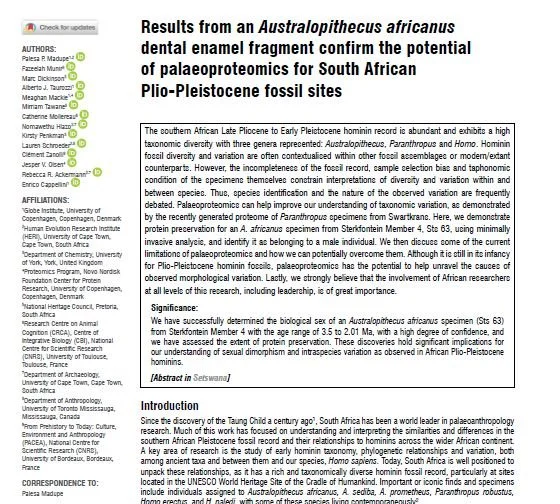
Dr Palesa Madupe and co-authors have been awarded the South African Journal of Science (SAJS) Outstanding Article Award for 2025 for their article Results from an Australopithecus africanus dental enamel fragment confirm the potential of palaeoproteomics for South African Plio-Pleistocene fossil sites.
Madupe, who is a member of the Human Evolution Research Institute (HERI), led the research with colleagues that included HERI members Dr Lauren Schroeder, Dr Nomawethu Hlazo and the institute’s Co-director Professor Rebecca R. Ackermann.
“This award recognises an impactful, collaborative approach to emerging new science, focused on lasting partnerships between those of us who belong to the global majority and the Western world,” says Madupe.
“It also underscores the potential for palaeoproteomics to help improve our understanding of the genetic differences that existed in early humans.”
High-quality research from Africa
The annual Outstanding Article Award acknowledges an outstanding peer-reviewed article published in SAJS that advances the mission of the SAJS to publish original high-quality research from Africa or on African-relevant issues.
SAJS articles aim to be of interest to readers in any discipline and for the benefit of scholars, educators, the general public and policymakers. They are also an important contribution to knowledge, are eloquent and accessible to the broad SAJS readership.
“That this article by Dr Madupe and her co-authors received such high engagement across SAJS’s readership, reflecting how effectively they presented cutting-edge technical research in an engaging and accessible way, enabling readers from diverse backgrounds to gain insight into our human heritage,” says Managing Editor Linda Fick.
A groundbreaking research technique
In this study, Madupe and colleagues used a groundbreaking research technique called palaeoproteomics to analyse a small fragment of tooth enamel from the fossil remains of Australopithecus africanus, the species that so-called Mrs Ples is part of, found at the Sterkfontein Caves in South Africa.
The results successfully determined the biological sex of the approximately 2.5 million-year-old specimen as male.
By identifying the sex of this fossil through proteins, the researchers shed light on how physical differences identified in ancient fossils are due to biological sex versus species diversity of our ancestors.
Although it is still in its infancy for Plio-Pleistocene hominin fossils, palaeoproteomics has the potential to help unravel the causes of observed morphological variation, said the researchers.
“We strongly believe that the involvement of African researchers at all levels of this research, including leadership, is of great importance,” they say.
“It was also important for us to publish our work in SAJS, a local community-run journal, in an effort to decolonise, democratise, and improve access to groundbreaking research.”