
Why do humans have chins? Research by HERI’s Lauren Schroeder has an answer
A paper by Lauren Schroeder and colleagues, published in January 2026 in the journal PLOS One, takes a fresh evolutionary look at one of the most distinctive features of the human face: the chin.
Humans are the only primates with a true chin, but why it evolved has long been debated. Using an evolutionary analysis of skull and jaw traits across hominoids, the study tests three competing hypotheses: that chin-related features evolved through genetic drift, under direct selection, or as a by-product (a “spandrel”) of selection and acting on other aspects of the skull and jaw.
The results reveal a complex picture. Strong directional selection is detected on the branch leading to modern humans after their split from chimpanzees, particularly affecting cranial traits linked to increased brain size, greater basicranial flexion, and reduced facial prognathism.
Mandibular traits also show directional change toward a more gracile, parabolic-shaped jaw. In contrast, most chin-specific traits do not show evidence of direct selection.
The takeaway? The human chin likely evolved as a by-product of other craniofacial changes tied to bipedalism and reduced tooth size, and not as a unique adaptation in its own right.
“This work offers new insight into how uniquely human features can arise without being direct adaptations,” says Schroeder, a member of the Human Evolution Research Institute (HERI).
She co-led the research with Noreen von Cramon-Taubadel from the University at Buffalo's, with colleagues Jill Scott from the Metropolitan State University of Denver, and Chris Robinson from City University of New York.
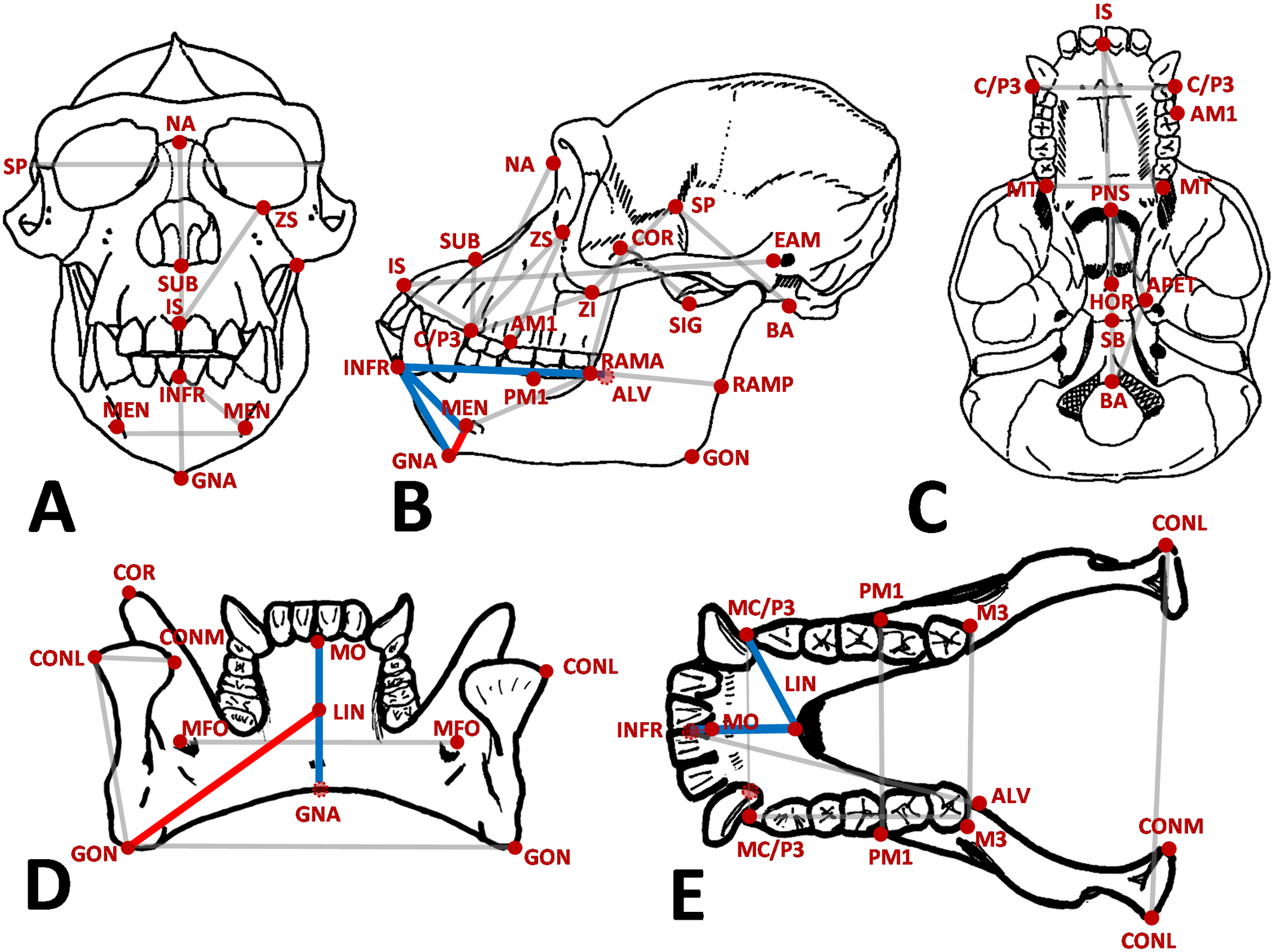
This figure from the PLOS One study shows craniomandibular traits found to be under significant direct selection (solid lines) to increase (red) and decrease (blue). Traits marked in either red or blue dashed lines were found to be under indirect selection. Traits in light grey did not return significant selection coefficients.