
Review of geochronology techniques led by HERI researchers
Leading scholars in U-series dating publish a big review paper nearly every decade, which sums up the state of the field at the time and provides direction for future research. These are well received by the research community and cement the leadership of the authors in this specialist field.
Historically led by a senior scientist, the latest review was published in December 2025 in the well regarded journal Quaternary Science Reviews, co-authored by early career researchers and HERI members Dr Rieneke Weij and Dr Tara Edwards.
Weij and Edwards use the review to analyse techniques such as isotope dilution versus laser ablation techniques, and share insights into research areas, such as dating flowstones found within fossil-rich samples.
Both Weij and Edwards are HERI Research Associates whose leadership in carbonate U-Th and U-Pb dating has been supported by the institute’s Co-director Associate Professor Dr Robyn Pickering. Indeed, Pickering was co-author on the last two U–Th and U–Pb reviews in 2015 and 2012.
“Taking the helm of this important review paper, Rieneke and Tara showcase the exciting geochronology research techniques that are shedding new light on human origins. At the same time, they capture a legacy of excellence in research championed by HERI that is carried further by its early career researchers,” says Pickering.
Establishing a timeline of geological events
Geochronology is the science of determining the age of rocks, fossils, and other Earth materials to establish the timeline of geological events or objects - like fossils. The study underpins much of what we know about past geological, climatic and environmental changes, as well as human evolution.
Identifying a timeline of the past requires analysis that gives accurate and precise dates. Carbonate dating that uses U–Th and U–Pb offer just that. However, recent advances in analytical techniques have improved both methods to refine their accuracy and precision, and expand their potential for use.
Among Weij and Edwards’ analyses is a comparison of isotope dilution versus laser ablation techniques, showing the latter as a rapidly developing method with outcomes that are faster and nearly as precise as the former.
“We hope our review serves as a valuable resource for both experienced users and researchers new to this field, including students, and highlights the exciting opportunities and range of potential for carbonate geochronology in the future,” says Weij.
Capturing clues about the past
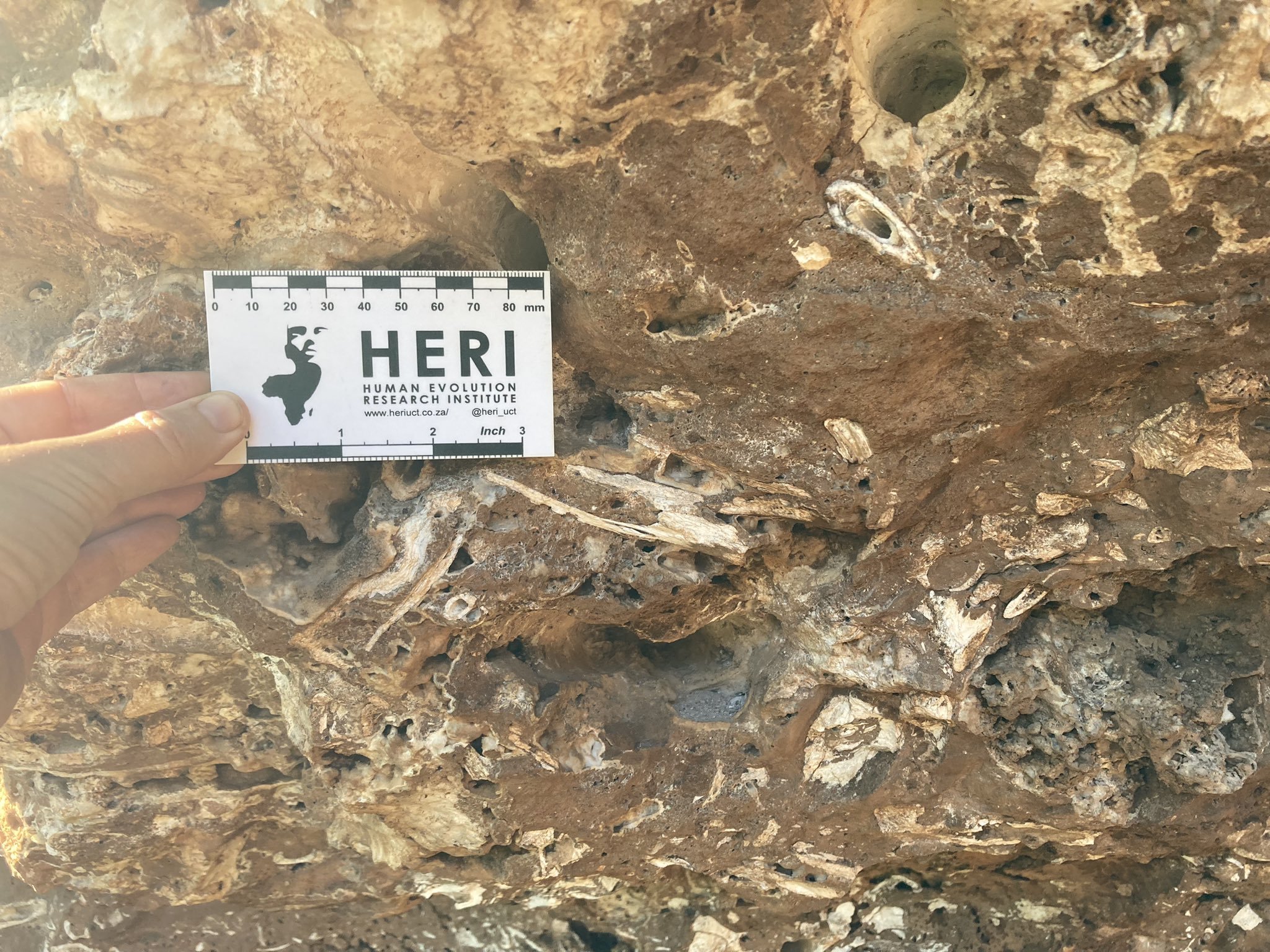
U–Th and U–Pb dating techniques have played an important role in human evolution research findings, especially when applied to flowstones from the Cradle of Humankind. Flowstones are geological formations that form in horizontal layers on floors and walls in all the caves. They form sequentially over millions of years as layers that capture clues about the past rainfall and temperature conditions above the caves.
Work led by Pickering used U–Pb dating to provide the first timeline for fossils from caves in the Cradle of Humankind. Edwards led work using U–Pb techniques to challenge the antiquity of the Cradle of Humankind.
Most recently, work led by HERI's Georgina Luti used U-Pb dating to dispute claims of flowstone intrusion. This research, published in the December issue of the journal Results in Earth Sciences, provides strong evidence supporting the U–Pb technique as the most robust way of dating both the caves and fossils of the Cradle.
“Our review highlights how carbonate geochronology and in particular, via laser ablation is rapidly becoming more accessible,” says Edwards, who is Chief Scientific Officer of the Laser Ablation and High-resolution Facility (LA-ICP-MS Lab) with the Biogeochemistry Research Infrastructure Platform (BIOGRIP).
“Having access to the kind of instrumentation we discuss in our review at BIOGRIP means students can learn advanced U–Pb techniques. This is key to building long-term capacity in a way we simply couldn’t before, and setting up a future where African researchers lead the science on African archives.”