
#HERIspotlight: Wendy Black
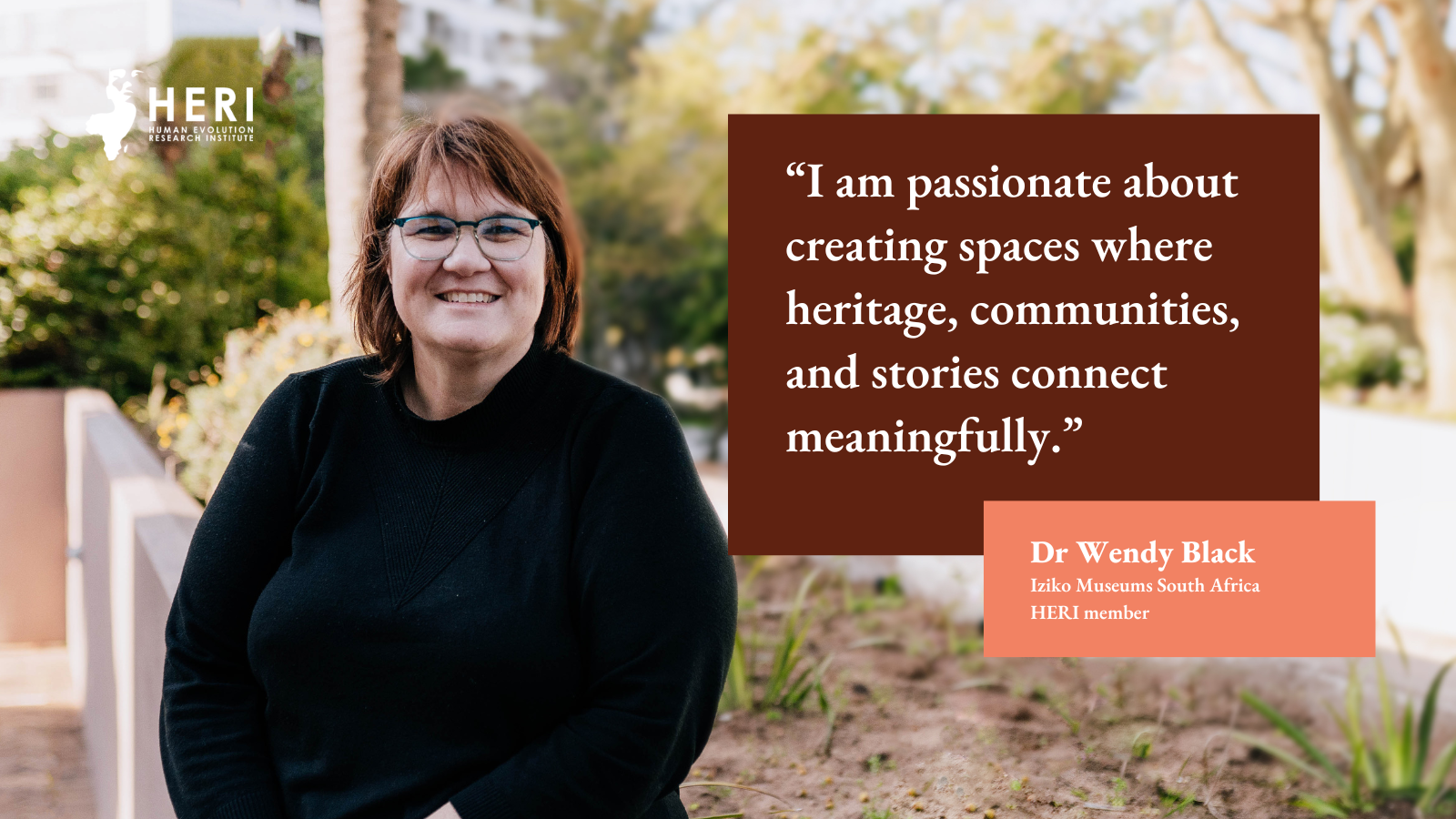
One of the founding members of HERI, Dr Wendy Black has played an important role in developing and guiding the strategic direction of the institute. As she steps away from her position as HERI leadership staff, she will focus on a new role at the Iziko South African Museum.
We celebrate her contributions to HERI and her commitment to strengthening inclusion and excellence in archaeology - and hold immense pride in watching her future journey take shape.
Black is the Director of Customer Services at Iziko Museums, and has spent most of her career working in museums. She holds a PhD in Archaeology from the University of Cape Town (UCT) and was previously Curator of Archaeology, and later Chief Curator at Iziko.
Her research has focused on the Later Stone Age of South Africa, particularly indigenous hunter-gatherers. She has also worked in bioarchaeology and more recently on repatriation, restitution, and museum transformation.
While archaeology was her first love, Black has always been passionate about museums. In the last year, she has shifted her focus towards managing large-scale heritage and infrastructure projects that help museums remain sustainable, accessible, and relevant for future generations.
The HUMANITY exhibition, done in collaboration with HERI and Iziko South African Museum, was curated by Black, who also spearheaded the community consultations and decolonial approaches used in its design.
While Black looks forward to the journey a new chapter at Iziko presents to her, she remains deeply interested in asking how museums can work more closely with communities, care for heritage in meaningful ways, and create spaces where history, culture, and people connect.
What excites you most about palaeoscience?
The opportunity to better understand people of the past. Palaeosciences allows us to ask fascinating questions about how people lived, moved, adapted, and interacted with one another over time. Every discovery adds another piece to a much larger human story and often challenges what we thought we knew.
Describe your research in three words.
In my role as Chief Curator: Ancestors, Museums, Justice.
In my current role: People, Places, Preservation.
Who is your biggest inspiration?
In my youth, it was definitely Indiana Jones. I was captivated by the adventure, discovery, and mystery of archaeology. As I grew older, however, I became more aware of the problematic themes around ownership, collecting, and representation that those stories often overlooked. Today, one of my greatest inspirations is Chimamanda Adichie, whose work speaks powerfully about African perspectives, identity, history, and reclaiming narratives that others have too often told.
What has been your biggest academic challenge?
Publishing. For a long time, I found academic writing intimidating and struggled with putting my work out into the world for critique. Learning that criticism is part of the process rather than a reflection of personal failure was an important lesson. Once I became more comfortable with feedback, writing became far more rewarding, although it is still not something I particularly enjoy.
What is the soundtrack to your studies?
I am very much a child of the electro-rock 1990s, so Depeche Mode is always near the top of my playlist. Depending on the day, it could be anything from Enjoy the Silence to People Are People. If there is research, writing, or exhibition planning to be done, there is a good chance Depeche Mode is playing in the background.