
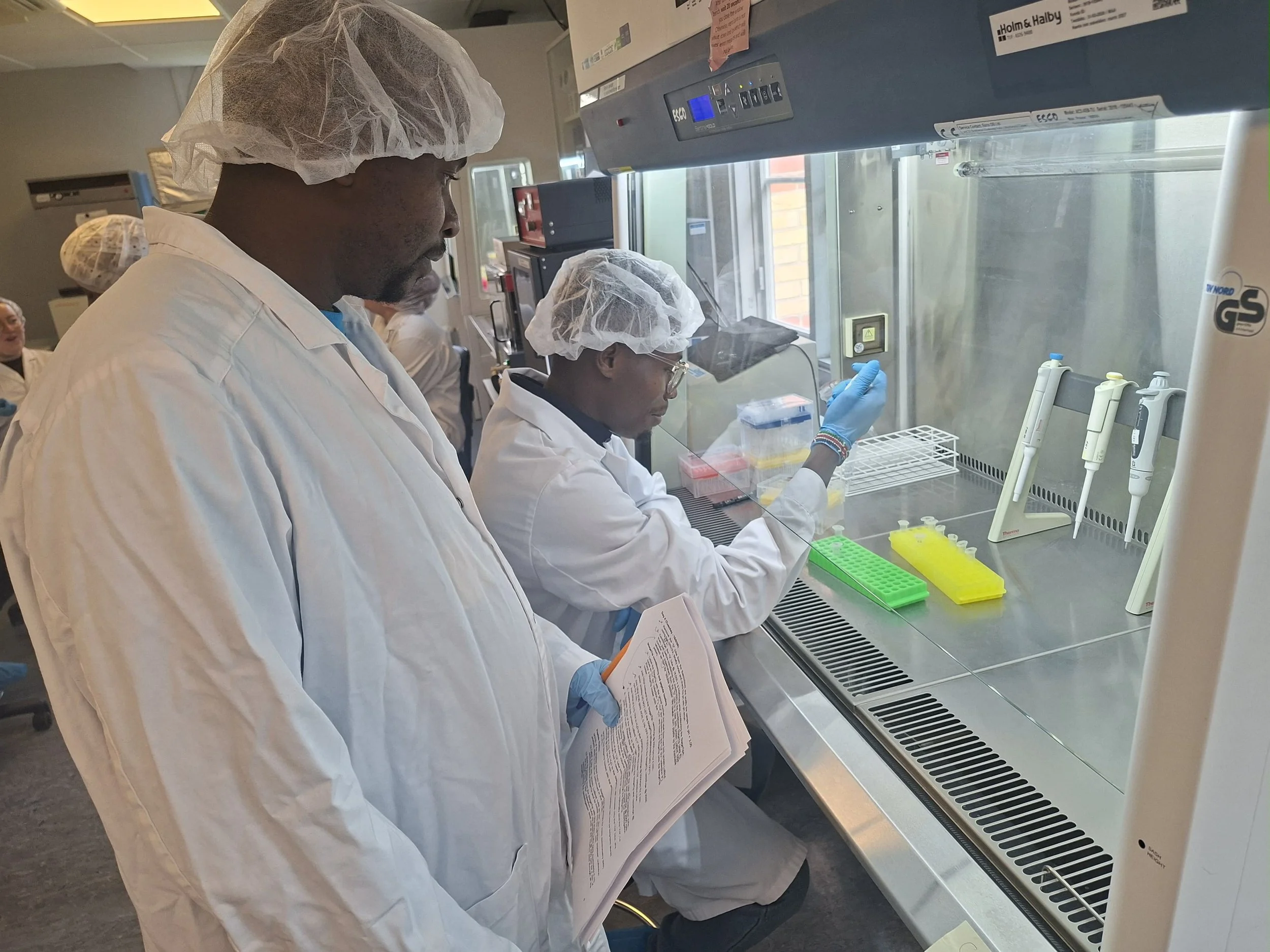
Norbert Odhiambo (wearing glasses and handling samples inside the biosafety cabinet) during a hands-on laboratory exercise at the Palaeoproteomics Summer School.
The study of human evolution is constantly expanding as researchers develop new ways to investigate the fossil and archaeological record. Palaeoproteomics is one of these approaches, and its application can provide valuable evidence for understanding evolutionary relationships, identifying species and investigating our shared human past.
Norbert Odhiambo, an Assistant Researcher at the National Museums of Kenya, attended the Palaeoproteomics Summer School at the University of Copenhagen in Denmark in August 2026. He joined the programme to gain theoretical knowledge, as well as laboratory and computational skills for studying ancient proteins and their applications in archaeology and evolutionary research.
Odhiambo’s participation was supported by the Pan-African Consortium for Human Evolution (PANACHE), an initiative managed by the Human Evolution Research Institute (HERI), that brings together researchers and institutions across Africa and the diaspora to build a continent-wide research network.
“The summer school provided me with valuable hands-on experience in palaeoproteomics, from extracting ancient proteins to analysing and interpreting mass spectrometry data,” says Odhiambo.
“It has opened up new opportunities to explore under-researched questions about past human health, diets and populations in Kenya.”
Exploring the science of ancient proteins
The Summer school kicked off in early August 2026, with Odhiambo joining participants in online sessions covering the fundamentals of palaeoproteomics. Topics included Zooarchaeology by Mass Spectrometry (ZooMS), a technique that helps identify animal species from bone fragments.
Also covered was ancient protein chemistry, including how proteins change and break down over time. Liquid chromatography-tandem mass spectrometry (LC-MS/MS), a technology used to separate and identify proteins in archaeological and fossil samples, was also introduced.
According to Odhiambo, these sessions explored how palaeoproteomics can be applied in cultural heritage, forensic investigations, art, archaeology and the study of past diets.
An overview of high-throughput proteomics, which allows researchers to analyse large numbers of samples, was also given. As was an introduction to peptide-reaction monitoring (PRM), a method that can help identify specific proteins and determine the biological sex of ancient remains.
Other topics included human and mammalian evolution, how changes in protein sequences can reveal evolutionary relationships, and phylogenetics, which helps researchers understand how species are related.
The training also covered the limitations of analysing ancient proteins, laboratory safety and sample preparation methods, says Odhiambo. Also introductions to SP3, a technique for cleaning and preparing protein samples, and using Metamorphous software to analyse protein data.
From lab procedures to data analysis
The second half of Summer School involved in-person practical training. Odhiambo explains that first on the agenda was an introduction to the equipment and techniques used to extract and prepare ancient proteins from archaeological samples for scientific analysis.
Participants learned how samples are processed and prepared before being examined using specialised equipment that helps researchers identify proteins. Participants also visited the Novo Nordisk Foundation Center for Protein Research, guided by Professor Enrico Cappellini, who directs the summer school.
The final sessions focused on analysing and interpreting results. Odhiambo says this centred on using computer software to identify proteins, examine data and investigate evolutionary relationships between species.
Notably, participants also explored how protein evidence can help determine the biological sex of ancient remains. The impact of this technique has already been demonstrated in research co-led by HERI’s Dr Palesa Madupe, working alongside Professor Cappellini and colleagues.
After successfully retrieving 2-million-year-old protein remains from teeth belonging to Paranthropus robustus, the research identified the biological sex and genetic variability of four ancient pre-human relatives.
Strengthening palaeoproteomics research in East Africa
For Odhiambo, the Summer School provided valuable theoretical, technical, practical and computational knowledge that is not only vital to advancing the research environment, but also requires continued mentorship and development.
He notes that palaeoproteomics remains relatively underdeveloped in East Africa, highlighting the need to investigate existing research gaps and nurture expertise in the field. PANACHE aims to deliver on that by fostering further collaboration among palaeoproteomics experts and researchers from the continent and diaspora.
Managed by HERI, PANACHE specifically supports African research capacity and more inclusive approaches to human origins research. By nurturing more inter-institutional exchange opportunities, such as the Summer School exchange Odhiambo participated in, it hopes to contribute to stronger African leadership in human origins research.