
Then and now: Reflections from HERI’s Advancing Womxn PhD fellows
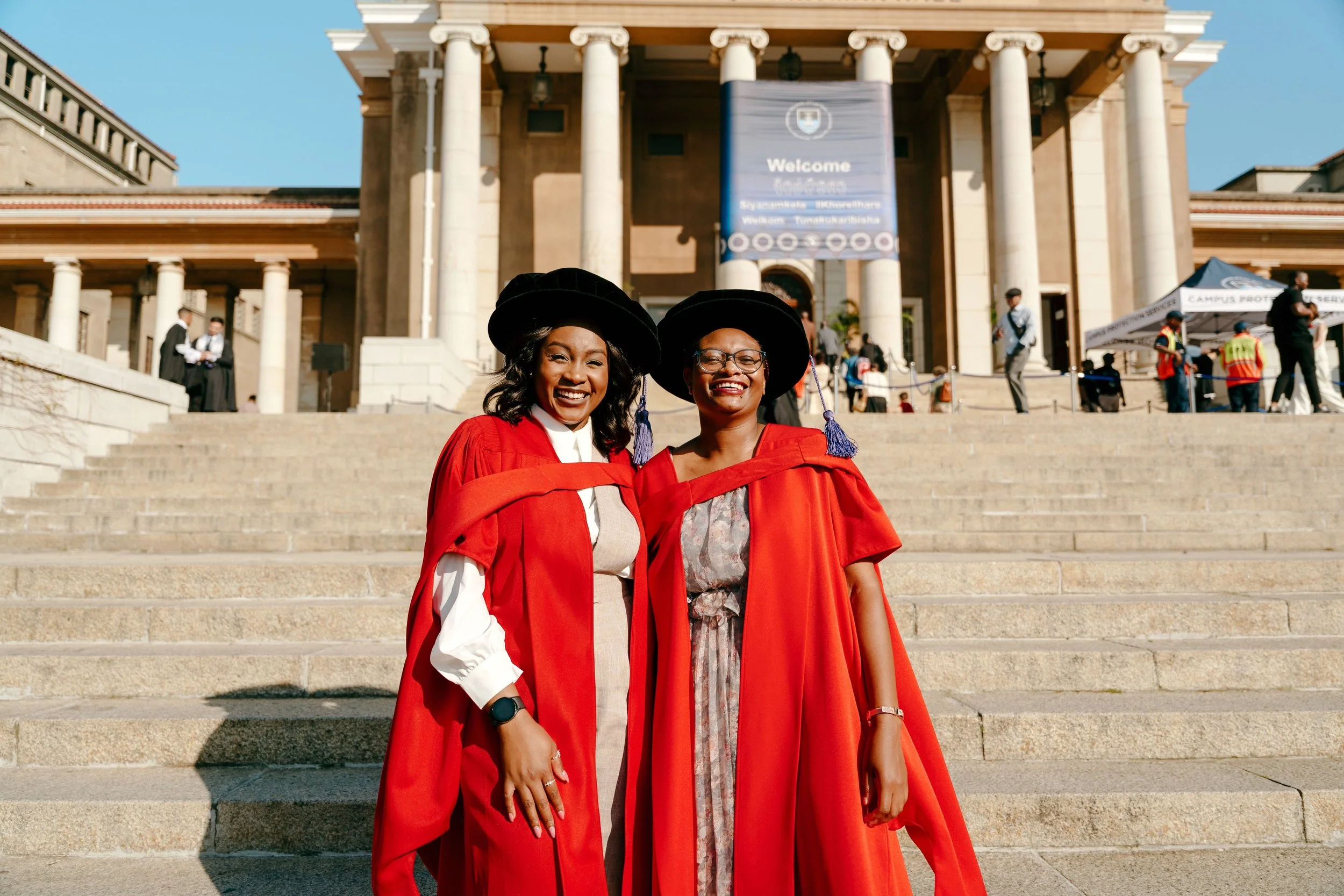
HERI's Advancing Womxn PhD graduates, Dr Rivoningo Khosa and Dr Precious Chiwara-Maenzanise. Credit: Robyn Walker
In 2020, HERI welcomed Precious Chiwara-Maenzanise and Rivoningo Khosa as its inaugural Advancing Womxn fellows. Both were beginning their PhD journeys in human evolution, with Precious working on Middle Stone Age archaeology and Rivoningo using cosmogenic isotopes to date landscape evolution.
These fellowships were made possible through the Advancing Womxn funding scheme, initiated by former UCT Vice Chancellor Professor Mamokgethi Phakeng. HERI was awarded a 5-year “for women by women” grant and earmarked part of the funding to support young Black women in human evolution specifically and the palaeosciences more broadly.
“HERI works to bring all voices into the conversation around human origins. With this award, we strengthen our mission and focus on welcoming more young, black women into human evolution," said HERI Co-director Associate Professor Robyn Pickering.
At the time, neither Precious nor Rivoningo could have predicted where their journeys would take them. Six years later, both graduated with their PhDs and grew remarkably as researchers. Here they reflect on their experiences as Advancing Womxn fellows at HERI.
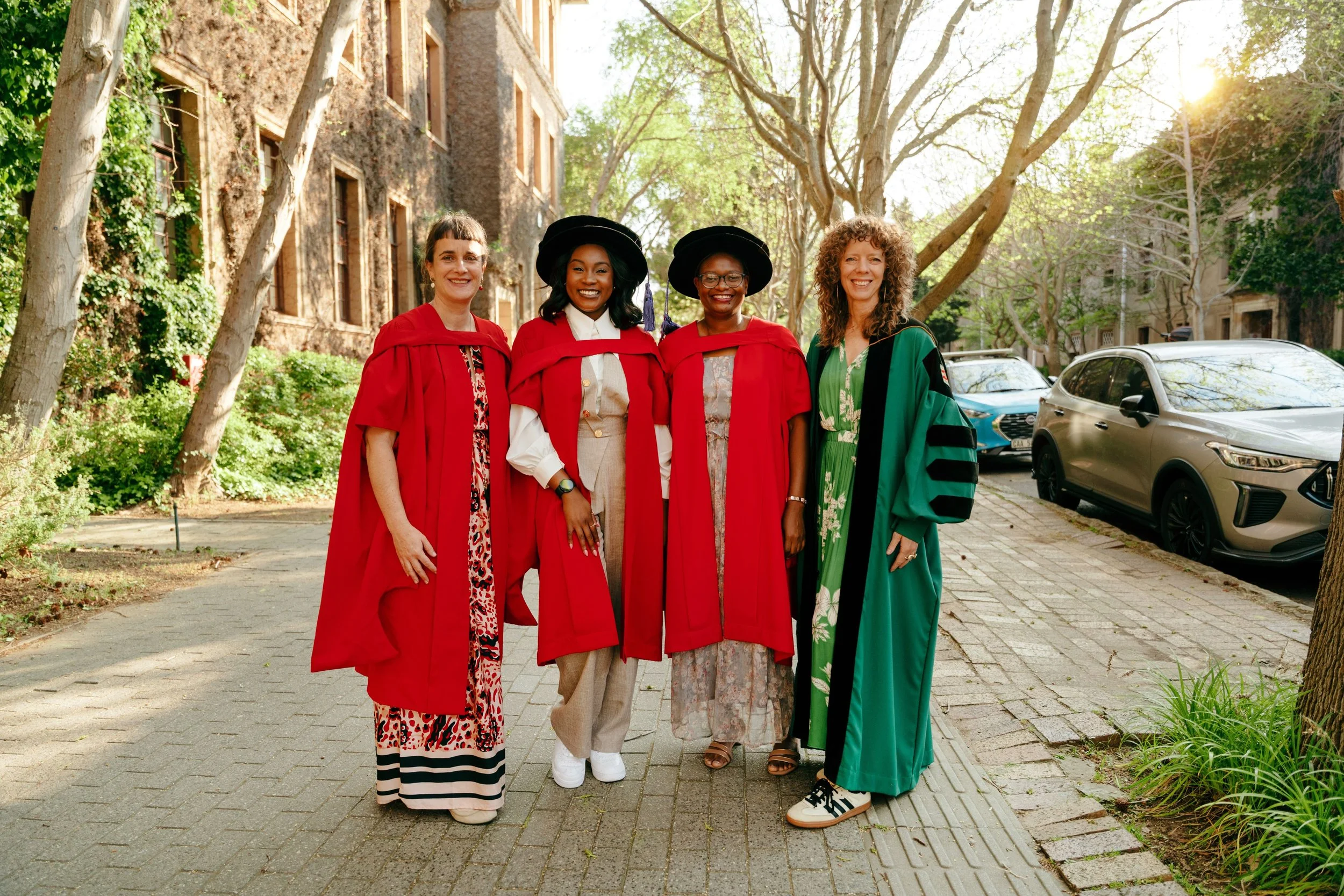
HERI's Advancing Womxn Fellows, Dr Rivoningo Khosa and Dr Precious Chiwara-Maenzanise (middle), with Co-Directors Associate Professor Robyn Pickering (left) and Professor Rebecca Ackermann (right). Credit: Robyn Walker
Important turning point in my career
Becoming an Advancing Womxn fellow was an important turning point in my academic career. I had studied archaeology at the University of Zimbabwe and was coming to the University of Cape Town (UCT) to begin my PhD with HERI. My research focused on early human social transmission in the Kalahari Basin.
When HERI welcomed me, I was excited about the opportunity to study at UCT and to continue working in a field where Black women were still underrepresented. I remember saying at the time that HERI’s aim of “uplifting black women in palaeosciences” was one of the things that attracted me most to the institute.
The PhD years were not always easy. I faced challenges with research, writing, fieldwork, and simply trying to find my place in science. Most importantly, I began my PhD during the COVID-19 pandemic, which brought its own unique challenges and uncertainties. But I had supervisors, colleagues, and funders who supported me along the way. HERI was always a central part of that support system.
Today, my research has developed beyond my PhD focus and into archaeological geochemistry, lithic raw-material provenance, and landscape use in the Kalahari. I am still asking questions about how early humans lived and interacted with their environments, but now with new approaches and a growing body of evidence that I have the experience and confidence to take forward.
Shared interest in understanding the past
I started my PhD in 2020, a time when so much of what we expected university and research life to look like was suddenly changed due to the COVID-19 pandemic. But the support that came from HERI was unmatched.
At HERI, I became part of a community of researchers working across different disciplines who were connected by a shared interest in understanding the past. The opportunities to engage with other researchers, present my work, and learn from those with different expertise helped broaden the way I thought about my own research.
My work focused on using cosmogenic isotopes to understand past environments through the evolution of fluvial systems, or natural networks of flowing water. The journey involved learning new and old techniques, improvising, working through difficult datasets, writing and rewriting, and steadily becoming more confident in my abilities as a scientist.
Looking back, I appreciate how much I grew during those years, both as a researcher and as a person. The journey taught me much more than the subject of my thesis. It taught me how to work through uncertainty, how to defend my ideas while remaining open to changing them, and how important the people and communities around you are to the research journey.
Six years after joining HERI as one of its first Advancing Womxn fellows, I am incredibly proud to have completed that journey and to be able to call myself Dr Khosa. I am also grateful that HERI was part of the journey from the very beginning.
And while I would not recommend starting a PhD during a global pandemic, if I were to do it again, I would choose to do it with HERI at UCT.
Where we started and where we are now
When the Advancing Womxn fellows were announced, Pickering had a powerful vision for what support from HERI could offer Precious and Rivoningo.
“My hope for Rivoningo and Precious is that they find an academic home at HERI, a place where they can thrive as researchers and do excellent science,” she said in 2020.
Since then, HERI has not only provided funding to these women, but offered new opportunities, a tight-knit community, and space to grow independently. And the mentorship, encouragement, and connection to the wider scientific community does not end with their PhDs.
“Precious and Rivoningo are not just excellent researchers, but leaders of the next generation of scientists that are changing how we understand the past record of both human and palaeoenvironmental evolution,” says Pickering.
“Southern Africa has an incredible record of our recent past, but not enough local experts studying it. One of our goals at HERI is to change this dynamic, so I am incredibly proud of both our #AdvancingWomen graduates and of what we have achieved as an Institute.”